Posted At: Jul 28, 2026 - 1,426 Views
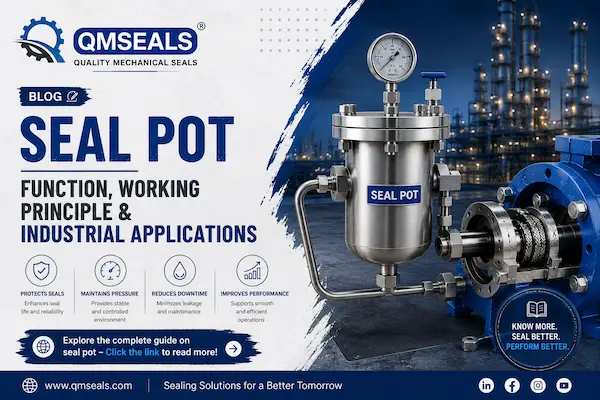
Seal Pot – Function, Working Principle & Industrial Applications
What Is a Seal Pot?
A seal pot (also called a seal reservoir or seal support vessel) is a closed pressure vessel connected to the seal chamber of a pump fitted with a double mechanical seal. Its job is to hold a clean fluid - either a buffer fluid or a barrier fluid - and circulate it continuously between the reservoir and the seal faces.
Without a seal pot, double mechanical seals have no reliable fluid supply. That means accelerated wear, overheating, and eventual seal failure.
How Does a Seal Pot Work?
The seal pot connects to the pump seal chamber via inlet and outlet piping. A pumping ring inside the seal assembly - or natural thermosiphon circulation - drives fluid from the reservoir into the seal chamber and back. Looking for more details on how a seal pot works? Click here to learn more.
This continuous loop does three things:
Lubricates the rotating seal faces, reducing friction and wear
Cools the seal by carrying heat away from the seal chamber back to the reservoir
Maintains pressure in the seal environment, preventing process fluid from escaping to atmosphere
In pressurized systems, nitrogen or a pump keeps the reservoir fluid above process pressure. In unpressurized systems, the reservoir sits at a lower pressure and acts as a leakage-detection buffer.
Seal Pot vs Condensate Pot – Key Differences
These two vessels look similar but serve different purposes. Mixing them up is a common and costly mistake.
| Feature | Seal Pot | Condensate Pot |
|---|---|---|
| Primary purpose | Barrier/buffer fluid reservoir for mechanical seals | Collects condensate in steam/vapor lines |
| Typical fluid | Clean oil, glycol, or compatible barrier fluid | Steam condensate or water |
| Application | Double mechanical seals on pumps | DP/level instrumentation in steam service |
| Pressure role | Active - maintains seal face pressure | Passive - stabilizes condensate head |
A seal pot actively protects rotating equipment. A condensate pot protects instruments from steam carryover. They are not interchangeable.
Types of Seal Pots
API Plan 52 Seal Pot (Unpressurized Buffer Fluid)
Plan 52 uses an unpressurized buffer fluid held at a pressure below the process pressure. The buffer fluid lubricates and cools the outboard seal faces. If the inboard seal leaks, process fluid enters the buffer circuit - triggering a level or pressure alarm. This makes Plan 52 ideal for non-hazardous or low-risk services where leakage monitoring is acceptable.
API Plan 53A Seal Pot (Pressurized Barrier Fluid)
Plan 53A uses a pressurized barrier fluid maintained above process pressure - typically via a nitrogen blanket. Because the barrier fluid pressure is higher, any leakage flows inward toward the process, not outward to atmosphere. This is the go-to configuration for toxic, flammable, or environmentally regulated services where zero atmospheric emissions are required.
Where Are Seal Pots Used?
Seal pots are standard equipment wherever double mechanical seals are specified. That covers most critical pump applications:
Chemical processing - isolates corrosive or reactive process fluids from seal faces and the environment
Oil & gas and refineries - handles hydrocarbon service where flammable fluid leakage is unacceptable
Pharmaceuticals - maintains product purity and prevents cross-contamination in sterile or sensitive process lines
Water & wastewater treatment - protects seal faces from dirty, abrasive, or chemically aggressive media
Power generation - used on boiler feed pumps and condensate pumps running at high temperature and pressure
Any pump handling a hazardous, toxic, or high-value fluid is a candidate for a double mechanical seal with a dedicated seal pot.
QMSEALS Seal Pot Solutions
QMSEALS designs and manufactures custom seal pots and complete seal support systems built to API 682 standards. With over 15 years of manufacturing experience, we supply units to clients across India, Dubai, Vietnam, Africa, and other global markets.
Our seal pots are available in:
Carbon steel, stainless steel (SS304/SS316), and exotic alloys for corrosive or high-temperature service
API Plan 52 and Plan 53A configurations, with all required connections, sight glasses, and instrumentation ports
Custom volumes and pressure ratings matched to your pump and process conditions
We also supply the complete seal support system - piping, instrumentation, mounting hardware, and the mechanical seal itself - as a single, tested assembly. One supplier, one point of accountability.
Get a quote for your seal pot requirement →Contact QMSEALS
Frequently Asked Questions
What is the purpose of a seal pot in a pump system?
A seal pot stores and circulates clean barrier or buffer fluid around the faces of a double mechanical seal. It keeps the seal lubricated and cooled, maintains the correct pressure environment, and - in Plan 52 systems - provides an early warning of inner seal leakage through level or pressure changes in the reservoir.
What is the difference between API Plan 52 and Plan 53?
Plan 52 uses an unpressurized buffer fluid at a pressure below the process. It's used when some leakage can be tolerated and monitored. Plan 53A uses a pressurized barrier fluid at a pressure above the process - typically nitrogen-assisted - so leakage is forced inward rather than out to atmosphere. Plan 53 is mandatory for toxic, flammable, or zero-emission services.
Do I need a seal pot for a single mechanical seal?
No. Single mechanical seals use a simpler flush arrangement (API Plan 11, 13, or 23, for example) and do not require a seal pot. A seal pot is specific to double mechanical seal configurations - either dual unpressurized (Plan 52) or dual pressurized (Plan 53A/B/C).
Can QMSEALS supply a complete seal support system with seal pot?
Yes. QMSEALS supplies the full assembly: seal pot, connecting piping, instrumentation (pressure gauge, level gauge, temperature port), and the double mechanical seal itself. Everything is sized and tested together before dispatch. Contact our technical team with your pump datasheet and we'll configure the right system.