Posted At: May 30, 2026 - 867 Views
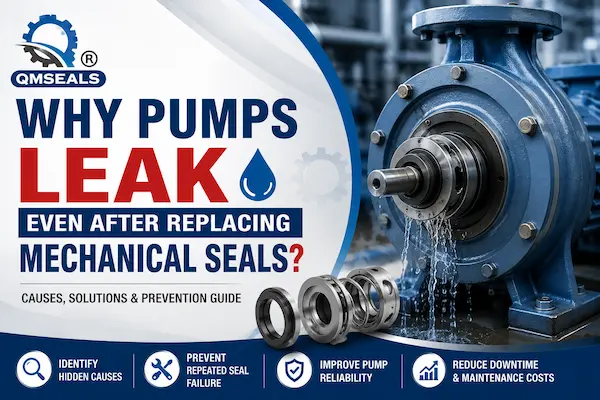
Why Pumps Leak Even After Replacing Mechanical Seals
It is a frustrating but incredibly common scenario in industrial maintenance: a centrifugal pump begins to leak, your team schedules downtime, pulls the pump, and carefully installs a brand-new, high-quality mechanical seal. You start the system back up, only to find fluid dripping—or spraying—from the exact same spot.
When a new mechanical seal is leaking, it is easy to blame the component itself. However, the reality is that mechanical seals are precision-engineered parts. If a new seal fails immediately or shortly after startup, the root cause almost always lies in the installation process, the pump’s mechanical condition, or the operating environment.
At QMSeals, we understand that downtime is costly. Here is a technical breakdown of why pump leaks occur after replacing mechanical seals and how you can prevent them.
1. Installation Errors: The Leading Cause of Early Failure
Mechanical seals operate with faces lapped to a flatness measured in light bands. The slightest mishap during assembly can compromise this micro-surface.
Fingerprints and Dirt on Seal Faces:Touching the seal faces with bare hands can leave skin oils that attract microscopic debris. When the pump starts, this debris scores the faces, creating an immediate leak path.
Incorrect Installation Working Length:If the seal is compressed too much, it generates excessive heat, causing thermal distortion. If it is not compressed enough, the faces will open under pressure.
Damaged O-Rings and Elastomers:Forcing a seal over a sharp shaft shoulder, keyway, or burr without proper lubrication can nick or tear the secondary sealing elements (O-rings or bellows).
QMSeals Pro-Tip:Always use the manufacturer-specified lubricants (that are chemically compatible with your process fluid) on elastomers, and never touch the lapped seal faces with your bare hands.
2. Mechanical Issues with the Pump
A mechanical seal cannot function properly if the pump itself is structurally compromised. If you didn’t check the pump's tolerances during the pump seal replacement, the new seal is likely doomed from the start.
Shaft Misalignment:If the pump shaft and motor shaft are not perfectly aligned, it creates radial forces that force the seal faces to shift unevenly. This leads to uneven wear and instant leakage.
Shaft Runout (Bent Shaft):A bent shaft or a shaft with high runout causes the seal components to oscillate dynamically. Mechanical seals can handle a tiny amount of movement, but excessive runout breaks the fluid film between the faces.
Bearing Wear:Worn-out bearings allow the shaft to move axially or radially. This movement translates directly to the seal faces, causing them to separate or chip.
3. Improper Priming and Dry Running
A mechanical seal relies on a microbar of the process fluid (or a flush fluid) to act as a lubricant and coolant between the rotating and stationary faces.
Dry Running:Starting a pump without priming it properly causes the seal faces to run dry. The friction generates extreme heat within seconds, leading to a phenomenon known as thermal shocking. This can crack hard faces like Silicon Carbide or Tungsten Carbide.
Airlock in the Seal Chamber:Even if the pump casing is primed, air can become trapped in the stuffing box or seal chamber. Without a proper flush plan (like API Plan 11 or 13) to vent the air, the seal will run dry.
4. Incorrect Seal Selection or Material Incompatibility
Sometimes, the problem isn’t how the seal was installed, but whatseal was installed. If the operating conditions of your process have changed (temperature, pressure, or chemical concentration), the old seal blueprint might no longer work.
Chemical Attack:If the process fluid attacks the elastomers (Viton, EPDM, Nitrile) or the face materials, they will degrade rapidly. For aggressive chemicals, switching to specialized materials like PTFE bellows or encapsulated O-rings is essential.
Pressure Spikes:Operating beyond the seal's pressure rating will distort the faces, allowing fluid to blow right through them.
How to Stop a Mechanical Seal from Leaking After Installation
To eliminate recurring mechanical seal failure causes, enforce this checklist during your next maintenance cycle:
Step | Action Item | Target Tolerance / Metric |
1 | Check shaft runout using a dial indicator. | Should ideally be < 0.05 mm(0.002 inches). |
2 | Inspect shaft sleeves for pitting or grooving. | Replace sleeve if any wear is visible. |
3 | Deburr keyways and sharp edges. | Protects O-rings during installation. |
4 | Verify API flush plans are clean and operational. | Ensures constant lubrication and cooling. |
5 | Ensure complete venting and priming before startup. | Prevents devastating dry-run scenarios. |
Conclusion
If pumps continue leaking even after replacing mechanical seals, the issue is usually deeper than the seal itself.
Problems such as shaft misalignment, vibration, cavitation, bearing failure, dry running, improper installation, or incorrect seal selection can all lead to repeated leakage.
Understanding these root causes is essential for improving equipment reliability and preventing recurring seal failure.
At QMSeals, we provide high-quality mechanical sealing solutions designed for demanding industrial applications. Our sealing products are engineered for durability, performance, and long service life across multiple industries.